There is a fairly widespread and quite erroneous view in society at large that anybody who is bilingual or even speaks a second language must necessarily be a good translator, as if being a translator and bilingual were synonymous. This is simply not true, and makes as much sense as saying that any native English speaker automatically must therefore write English well.
Not only must the translator write as well as the author, but he or she must also read the original text much more closely and with much greater detail than most people tend to do. As Gregory Rabassa, translator of Gabriel Garcia Marquez’s One Hundred Years of Solitude puts it: “I have always maintained that translation is essentially the closest reading one can possibly give a text.” (From The Craft of Translation, University of Chicago Press, edited by Biguenet & Shulte).
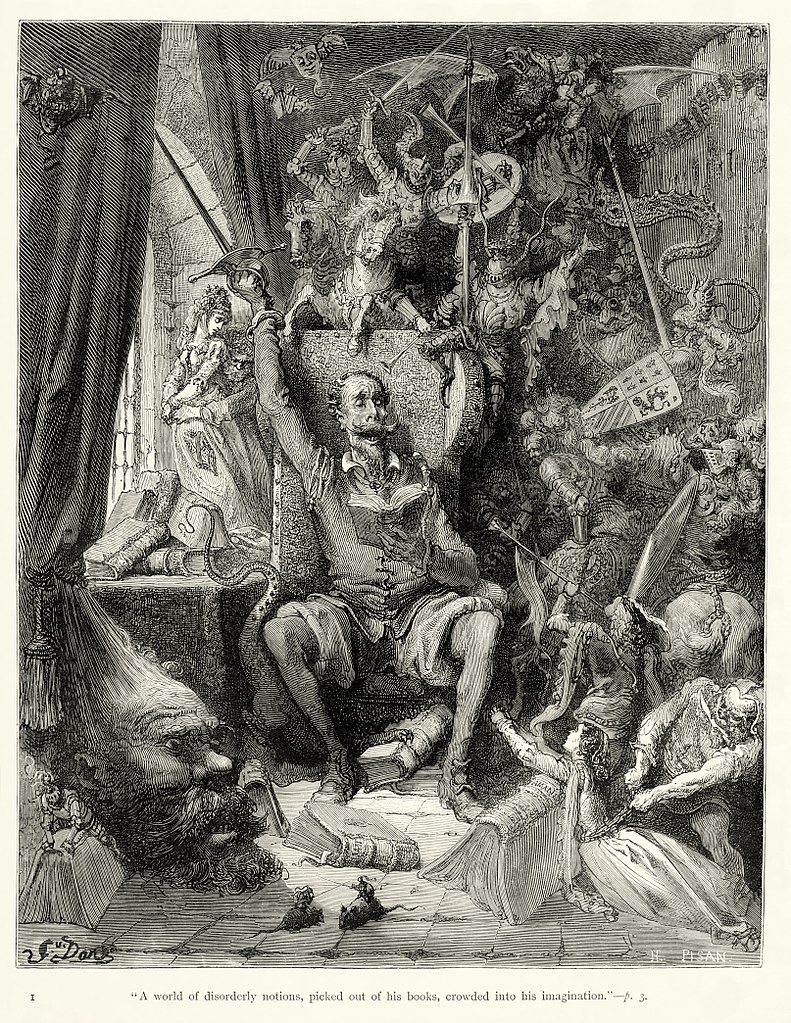
To illustrate just to what extent different translators bring different readings to the same work, and also how, even when their readings coincide, they will reach for different words to convey the same meaning for reasons that can only be described as personal, I have provided two sentences translated by five different translators of Don Quixote, which was written by Miguel de Cervantes, and first published in 1605 in Madrid, the city where I lived for many years.
I have chosen Don Quixote because it is the most famous work of prose in the Spanish language, and is widely considered to be the first modern novel. Indeed, in a recent poll by the Norwegian Nobel Institute, in which leading international writers were asked to vote for “best and most central works in world literature”, Don Quixote came out top by some distance.
That Don Quixote continues to be so relevant today is due, in no small part, to those translators who have carried it over to their own language over the centuries, and what follows should not be understood as a criticism of any of the translators mentioned. By the same token, any translation is susceptible to criticism.
There have been many translations of Don Quixote over the years, and I have chosen just five of these though there are others which could just as easily have been included. The five translations I have chosen include the first translation of “Don Quixote”, carried out by Thomas Shelton (1612 and 1620) which was the first translation into any language of Cervantes’ novel. From the eighteenth century, I have chosen the version of Tobias Smollett (1755), and from the nineteenth, John Ormsby (1885). I have also included the versions of two contemporary translations, one from the Oxford professor John Rutherford (2000) and the other from American translator, Edith Grossman (2003), both highly of whom are two of the most highly respected translators working today.
I have chosen the first line of “Don Quixote”, because it perhaps the most famous line of prose in the world, which reads as follows in Spanish:
En un lugar de la Mancha, de cuyo nombre no quiero acordarme, no ha mucho tiempo que vivía un hidalgo de los de lanza en astillero, adarga antigua, rocín flaco y galgo corredor.
For the second sentence I have selected the description of Don Quixote, for the simple reason that he must be the most famous literary character in prose, and who Cervantes describes in the following way:
Frisaba la edad de nuestro hidalgo con los cincuenta años, era de complexión recia, seco de carnes, enjuto de rostro; gran madrugador y amigo de la caza.
Here are the five different versions:
Thomas Shelton:
“There lived not long ago, in a certain village of the Mancha (the name of which I purposely omit) a gentleman of their calling that used to pile up in their hall old lances, halberds, morions and other such armours and weapons”.
“The master himself was about fifty years old, of a strong complexion, dry flesh, and a withered face”.
Tobias Smollett:
“In a certain corner of La Mancha, the name of which I do not choose to remember, there lived lately one of those country gentlemen, who adorn their halls with a rusty lance, a worm-eaten target, and ride forth on the skeleton of a horse, to course with a sort of starved greyhound”
“Our squire, who bordered upon fifty, was of a tough constitution, extremely meagre and hard-featured, an early riser, and in point of exercise, another Nimrod.”
John Ormsby:
“In a village of La Mancha, the name of which I have no desire to call to mind, there lived not long since one of those gentlemen that keep a lance in the lance-rack, an old buckler, a lean hack, and a greyhound for coursing.
“The age of this gentleman of ours was bordering on fifty; he was of a hardy habit, spare, gaunt-featured, a very early riser and a great sportsman.”
John D. Rutherford:
“In a village in La Mancha, the name of which I cannot quite recall, there lived not long ago one of those country gentlemen or hidalgos who keep a lance in the rack, an ancient leather shield, a scrawny hack and a greyhound for coursing”.
“Our hidalgo himself was nearly fifty; he had a robust constitution, dried up flesh, and a withered face, and he was an early riser and a keen huntsman”.
Edith Grossman:
“Somewhere in La Mancha, in a place whose name I do not care to remember, a gentleman lived not long ago, one of those who has a lance and an ancient shield on the shelf and keeps a skinny nag and a greyhound for racing”.
“Our gentleman was approximately fifty years old; his complexion was weathered, his flesh scrawny, his face gaunt, and he was an early riser and a good love of the hunt.”
As you can, see, these translations differ in so many different ways.
A few very brief observations on each of these sentences. None of these criticism should be taken to devalue the overall quality of the translations mentioned, which each reader should discover for him or herself:
Shelton: The norms of translation have changed much over the centuries, and translation studies as a discipline is relatively new. Shelton’s translation would seem lax to most translators today. Cervantes doesn’t say “the name of which I purposely omit” but instead, word for word, a place in La Mancha “whose name I do not want to remember” or better said, I do not wish to recall.
Smollett: Smollett’s opening line would come in for the same kind of criticism as Shelton’s, and it would be fair to say that La Mancha, with its flat plains, hardly strikes one as being a place with a “corner” which Cervantes says nothing about in any case. He writes “In a place in La Mancha….”
Ormsby: Ormsby shows us that words change their meaning over time, and that new translations of classics will always be required. Cervantes says Don Quixote is “amigo de la caza”, literally, a friend of hunting, but Ormsby uses “sportsman” to convey the idea of hunting. A sportsman these days means something completely different to what it did in nineteenth century Britain.
Rutherford: In his description of Don Quixote, Cervantes translates “seco de carnes”, literally “dry of flesh” which Rutherford renders “dried up flesh”. Here, I prefer Ormsby’s “spare” or better still skinny or scrawny. “Seco de carnes” as I read it, does not refer to whether Don Quixote has dry skin but to the absence of flat or flab on his body, something borne out by the fact that he is “enjuto de rostro”, or otherwise said, “gaunt faced.”
Grossmann: Edith Grossmann, one of the finest translators writing today, gives us all hope by making a straight forward mistake, something almost inevitable in almost all translations it should be said. Like Shelton, she passes over the fact that “complexion” is a false friend, a word which reads the same in two different languages but means something different in each one. Complexion in Spanish refers to one’s constitution or physical build. When Cervantes says Don Quixote is “de complexion recia” he means he is of a hardy constitution.
Finally, I offer my own version of the two sentences referenced above, which somebody else can no doubt criticize too.
“In a place in La Mancha, whose name I do not wish to call to mind, not long ago there lived a bonnet laird, one of those with a lance in the rack, ancient targe, a skinny nag, and greyhound for racing.”
“Our laird was bordering fifty, of a hardy constitution, somewhat skinny and gaunt faced, an early-riser, and a keen huntsman.”
 Douglas Stuart Wilson